


In 2022, a Polish entrepreneur succeeded in registering the trade mark HAALAND in the EU for a broad range of goods and services – from football-related products such as cards, kits and football boots, to cosmetics, watches, jewellery, food products, training services and licensing services.
Erling Braut Haaland subsequently filed an application to register the word mark ERLING HAALAND in the EU. However, the Polish entrepreneur opposed the application on the grounds that ERLING HAALAND was liable to be confused with his registered trade mark HAALAND. As a countermeasure to the opposition, we, on behalf of our client Haaland, sought the cancellation of the EU registration on the basis that it had been filed in bad faith. EUIPO’s Cancellation Division upheld our claim and ordered that the registration be cancelled in its entirety, finding it evident that the Polish entrepreneur was aware of the footballer Haaland’s celebrity status and that the sole purpose of the HAALAND registration was to exploit it.
The Polish entrepreneur, however, chose to appeal the decision. In a ruling dated 20 May 2026, the EUIPO’s Board of Appeal likewise found that the HAALAND registration must be cancelled, as the application had been filed in bad faith. The Board of Appeal concluded that the applicant’s intention in filing the application was dishonest and solely aimed at exploiting Haaland’s name and reputation, as well as benefiting from the commercial value associated with it. The registration was therefore ordered to be cancelled in its entirety.
Further details of the decision
In its assessment, the EUIPO’s Board of Appeal placed significant weight on the evidence submitted in the case. The evidence demonstrated that, already at the time of filing of the contested trade mark application, Erling Braut Haaland was a highly recognisable figure throughout the EU, including in Poland. Haaland was not only widely covered in European media generally, but also received particular attention in Poland. As a nation with a strong interest in football, and with international figures such as Robert Lewandowski, Haaland has also enjoyed considerable media coverage in the Polish press. The Board of Appeal therefore found it inconceivable that the Norwegian footballer was not also known to the relevant Polish public at the time the application was filed.
A further factor taken into account in this case was the proprietor’s own business activities prior to the trade mark registration. It was established that he had previously operated within the construction and installation sector in Poland. At the same time, he applied to register the trade mark HAALAND for a wide range of goods and services that largely fall within the fields of sport, clothing and commercial merchandising. The Board of Appeal considered this to be far from coincidental. Where an entrepreneur with no connection to sport suddenly seeks to register a trade mark such as HAALAND for precisely those goods and services commonly associated with successful athletes, this reinforces the impression that the intention was not to build an independent brand, but rather to exploit an already established value. This supported the conclusion that the registration had been made in bad faith.
The future of Haaland’s trade marks
Haaland has already registered the trade marks IR 1757299 (lotus celebration) and IR 1757298 (EBH9), both in the EU and in several other parts of the world.
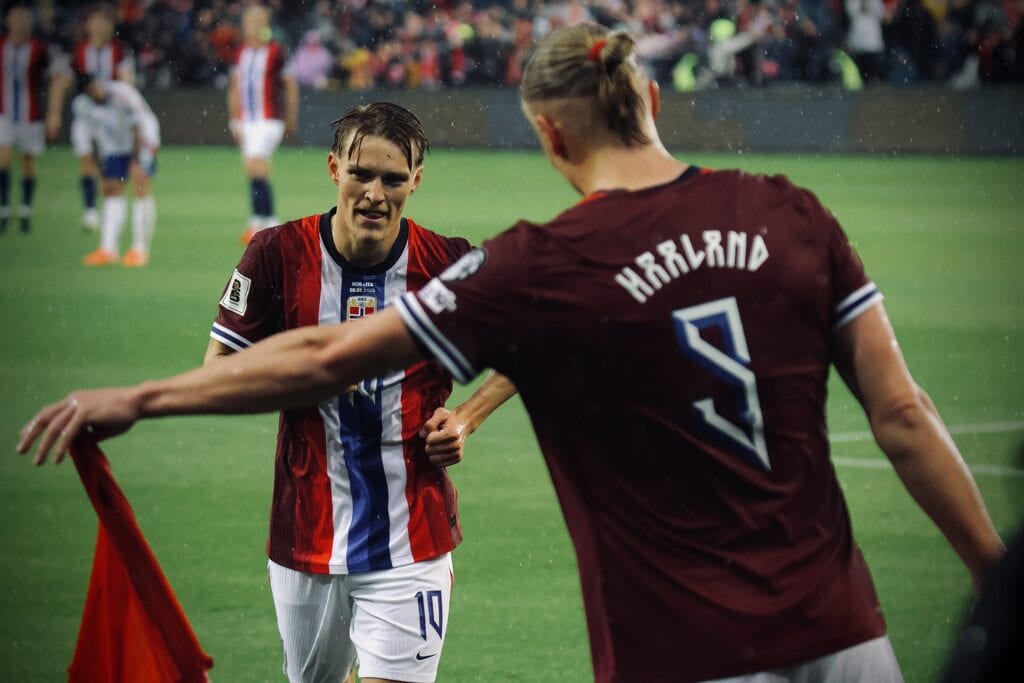
Although the Polish entrepreneur may still appeal the case, the EUIPO’s decision indicates that the way is now clear for the registration of the trade mark ERLING HAALAND in the EU as well.
This means that Haaland has now secured the right to his own name as a trade mark, and can therefore control and exploit its commercial value.
Fotocredit: By MichaelEmilio – Own work, CC BY 4.0, Wikimedia Commons
Key takeaways from the case
Although the case concerns a world-renowned footballer, the underlying issue is far from unique. We regularly see trade marks being registered that may be confused with the distinctive signs of others, whether intentionally or unintentionally. Once this happens, it can be both time-consuming and costly to put matters right.
The best strategy is therefore to be proactive. Securing trade marks at an early stage provides control, predictability and a much stronger foundation for future growth. At the same time, it is important to remain vigilant and be aware that there may still be opportunities to secure the rights to your own name and trade mark, even if someone else has filed an application earlier.
At Håmsø, we assist both in securing trade marks and in enforcing rights when conflicts arise.
Please contact us if you would like to have control over your brand – before, during or after a conflict arises, both in Norway and internationally.